Why Case Studies Make Projects Look More Professional
Why project detail pages should explain process, challenges and outcomes instead of only showing images.
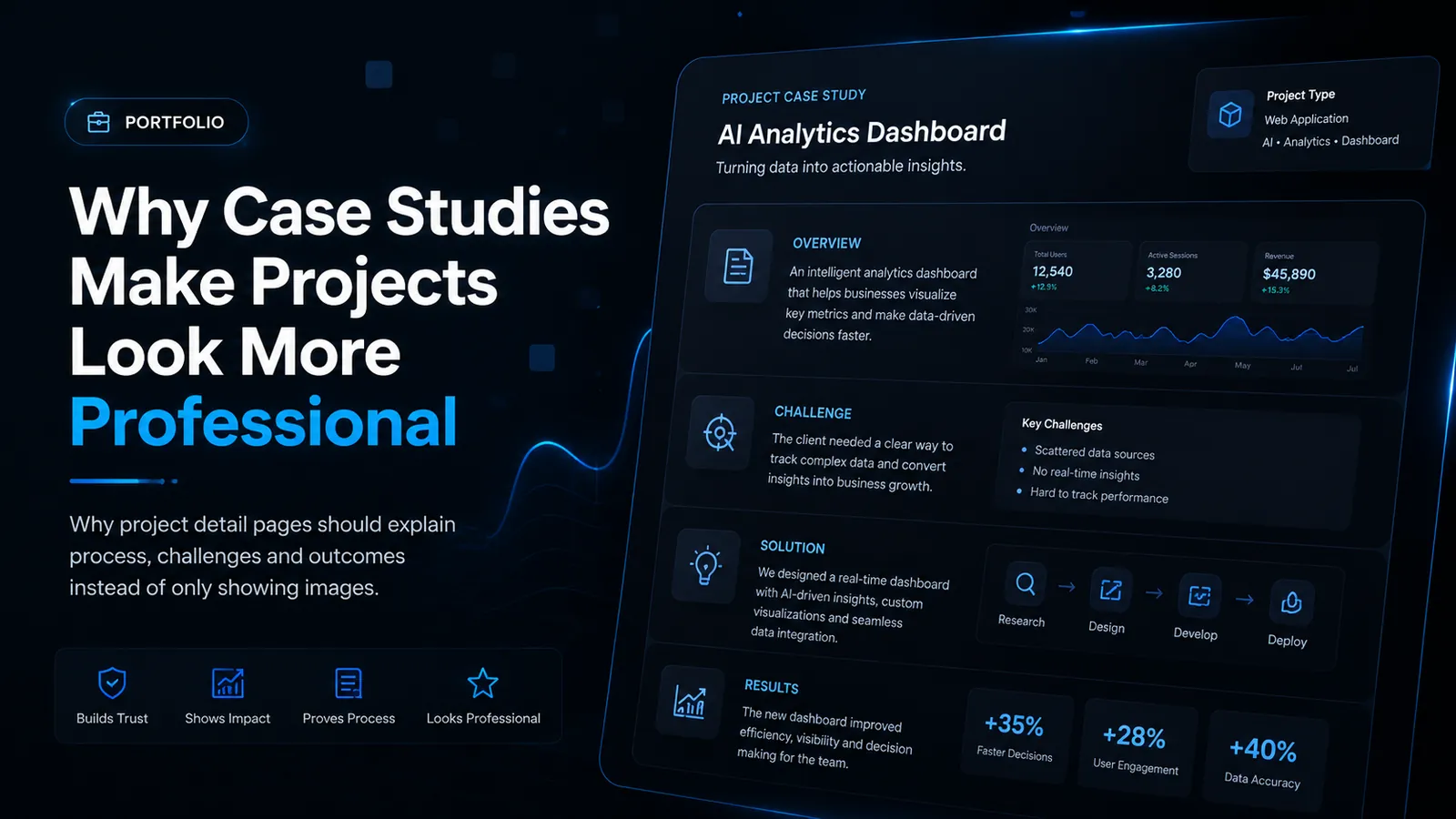
A project card can show what you made, but a case study explains why it matters. This difference is important. Many portfolios show screenshots, titles and short descriptions, but they do not explain the thinking behind the work. As a result, the viewer sees the final output but does not understand the process, the challenge, the decision-making or the value created.
A case study changes that completely. It turns a project from “something I made” into “a problem I solved.” This is exactly what companies, clients and recruiters want to see. They are not only checking whether a project looks nice. They are checking how you approach real problems, how you structure your work and whether you can explain technical details clearly.
For a portfolio that includes AI, web systems, cybersecurity, game development, data analysis, e-commerce and VFX, case studies are even more important. Without case studies, a multidisciplinary portfolio can feel scattered. With case studies, it feels professional, structured and intentional.
What Is a Project Case Study?
A project case study is a detailed explanation of a project from start to finish. It usually explains the problem, objective, tools, process, features, challenges, solution and outcome. It gives the viewer context.
A normal project card may say:
“The Miner’s Spice Restaurant Platform — restaurant website with ordering and booking.”
A case study explains much more:
“The Miner’s Spice Restaurant Platform was designed to support a restaurant’s digital operations by combining online ordering, table booking, menu presentation, customer contact, allergen communication and admin management into one business-ready web system.”
That second version sounds more professional because it explains purpose and value. It helps the reader understand that the project is not just a design, but a working business solution.
Why Recruiters Prefer Case Studies
Recruiters and hiring managers often review many portfolios quickly. A screenshot may catch attention, but a case study builds trust. It shows that you can explain your work in a professional way.
Case studies help recruiters understand:
- What problem you solved
- What your role was
- What tools and technologies you used
- How you made decisions
- How you handled challenges
- What the final outcome was
- How the project connects to business or user needs
This matters because companies do not hire only for tool knowledge. They hire people who can solve problems. A case study gives proof of problem-solving ability.
For example, if you are applying for a web developer role, a case study about AutoMarketPro can show marketplace logic, seller dashboards, Stripe payments, image uploads, search filtering and admin moderation. If you are applying for an AI role, the Q-Learning Grid World Agent can show algorithmic thinking, reward systems, training evaluation and result analysis. If you are applying for cybersecurity, DVWA labs and PenTest-Ont can show structured security knowledge.
Case Studies Make Student Projects Look Industry-Ready
A common issue for students is that projects may look academic or unfinished. However, a good case study can make an academic project look highly professional.
For example, a Q-learning assignment can become a strong AI case study by explaining:
- Reinforcement learning background
- Grid-world environment
- Agent behaviour
- Reward and penalty design
- Epsilon-greedy exploration
- Q-table update method
- Results and graphs
- Lessons learned
This turns a coursework task into a professional AI research portfolio item.
The same applies to a Coursera digital transformation assignment. Instead of presenting it only as university coursework, it can be framed as a digital strategy case study. It can explain digital maturity, AI personalisation, learner analytics, platform business models and future innovation. That makes the work useful for business technology, data strategy and digital transformation roles.
The Best Case Study Structure
A strong case study does not need to be complicated. It should be easy to scan and easy to understand.
1. Project Overview
Start with a short summary. Explain what the project is, who it is for and what it does.
Example:
“SmartCV AI CV Analyzer is an AI-powered platform designed to help job seekers improve their CVs through ATS scoring, keyword analysis and personalised improvement suggestions.”
2. Problem Statement
Explain the problem clearly. The problem should sound real and practical.
Example:
“Many job seekers have relevant skills but fail to pass applicant tracking systems because their CVs lack role-specific keywords, clear structure or measurable achievements.”
3. Project Objectives
List what the project aimed to achieve. Objectives should be direct and measurable where possible.
Example:
- Analyse CV structure
- Identify missing keywords
- Generate ATS-friendly suggestions
- Improve candidate presentation
- Provide a clean user dashboard
4. Tools and Technologies
Mention the stack. This helps technical viewers understand your ability quickly.
Example:
PHP, MySQL, Stripe, JavaScript, Supabase, Python, Unity, Blender, OWL, Protégé, SPARQL, React, Node.js or PostgreSQL.
5. System Design or Workflow
This section makes the project more professional. Add diagrams if possible:
- User flow diagram
- Data flow diagram
- System architecture
- ERD
- AI workflow
- Admin panel workflow
- Security workflow
Even a simple diagram can make the project look more complete.
6. Key Features
Explain the main functionality in a table or bullet list. For example:
Feature
Description
User Dashboard
Allows users to manage personal data and project activity
Admin Panel
Supports content, users and system updates
Payment Flow
Handles secure checkout using Stripe
Documentation Download
Allows users to download project files
7. Challenges and Solutions
This is one of the most important sections. It shows maturity. Do not hide challenges. Explain them professionally.
Example:
“During development, one challenge was organising multiple portfolio categories without breaking the existing static GitHub Pages structure. This was solved by using JSON-driven data and category filters.”
8. Outcome
Explain the final result and impact. Even if the project is a prototype, describe what it demonstrates.
Example:
“The final system demonstrates full-stack marketplace logic, payment readiness, seller-side listing management and admin moderation.”
How Case Studies Improve SEO
Case studies also help Google understand your website better. A portfolio page with only images has limited searchable content. A case study page with headings, keywords, descriptions and internal links gives search engines more context.
For example, a page titled “AutoMarketPro Car Marketplace Case Study” can rank for terms like:
- car marketplace project
- PHP marketplace project
- Stripe payment integration project
- web development portfolio case study
A page titled “Q-Learning Grid World Agent Case Study” can rank for:
- Q-learning project
- reinforcement learning portfolio
- AI student project
- grid world agent Python
This is why detailed case studies are valuable. They improve both human readability and search visibility.
External Authority Links to Add
Suggested authority links:
- Google Search Central for SEO content guidance
- Nielsen Norman Group for UX case study and usability ideas
- GitHub Docs for project hosting and repository structure
- OWASP for security case study references
- Stripe documentation for checkout/payment projects
Conclusion
Case studies make projects look more professional because they explain the value behind the work. They show process, problem-solving, technical decisions and outcomes. A project card may attract attention, but a case study builds trust.
For a multidisciplinary portfolio, case studies are essential. They help connect different skills into one clear professional story. Whether the project is AI, cybersecurity, web development, game development, e-commerce or VFX, the case study format gives it structure and credibility.
A strong portfolio should not only say, “Here is what I built.” It should say, “Here is the problem, here is how I solved it, and here is why it matters.”