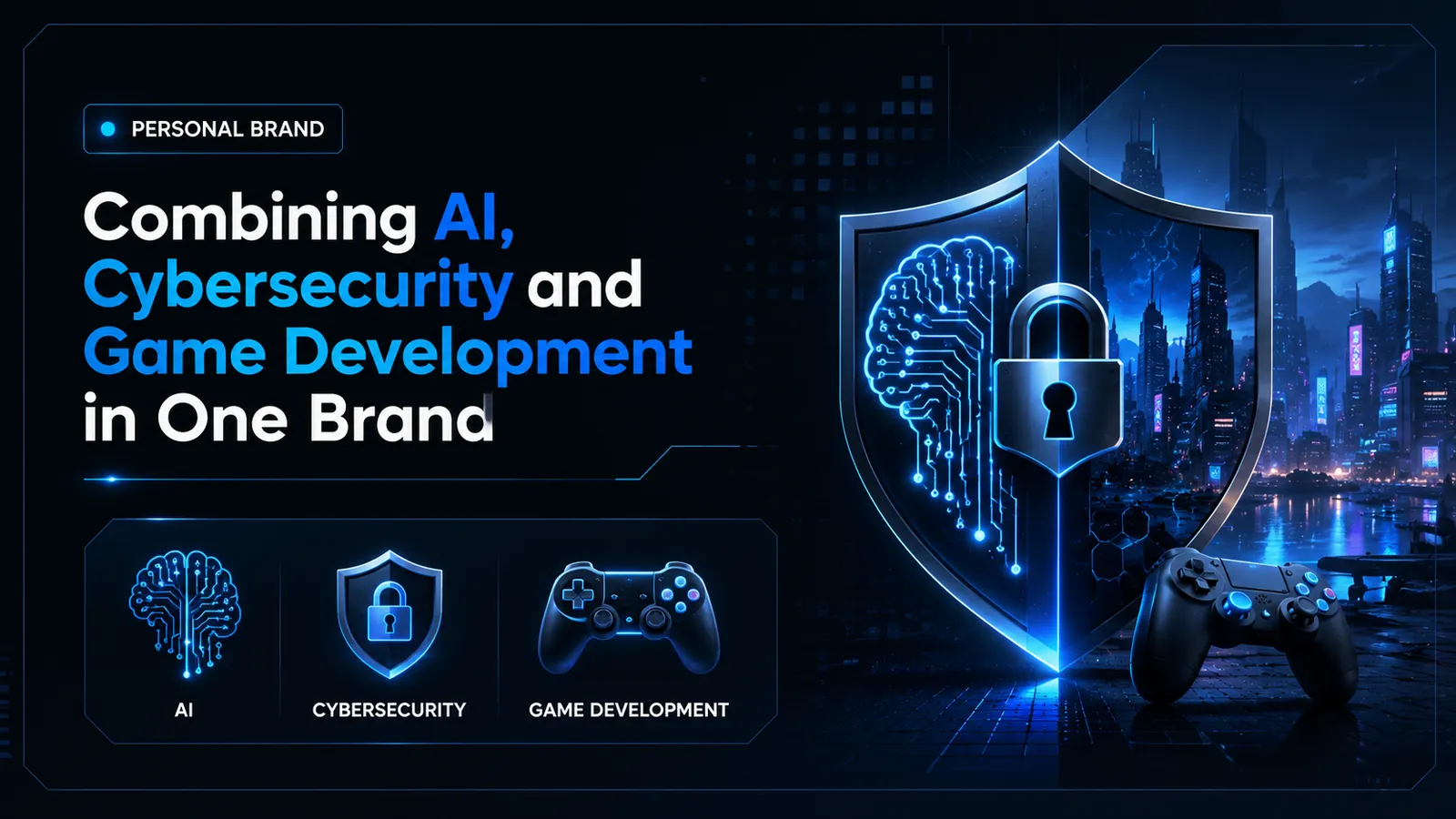
Combining AI, Cybersecurity and Game Development in One Brand
A focused way to connect multiple skills without making the website feel confusing.
Building a personal brand becomes more challenging when your skills cross multiple fields. Someone who only focuses on frontend development can build a simple frontend portfolio. Someone who only focuses on game development can present game projects. Someone who only works in cybersecurity can show labs, reports and certifications. But when your background includes AI, cybersecurity, web systems, game development, 3D animation, VFX and video editing, the question becomes: how do you connect everything into one professional identity?
The answer is not to hide your different skills. The answer is to organise them under one clear direction. A modern personal brand can be multidisciplinary if it has a strong message. The goal is to show that your skills are connected by the type of work you do: building intelligent, secure and visually strong digital systems.
AI, cybersecurity and game development may seem different at first, but they actually connect very well. AI focuses on intelligence and automation. Cybersecurity focuses on protection, risk and trust. Game development focuses on interaction, simulation and immersive experience. Together, these skills create a powerful identity for someone who can build smart systems, secure them and present them with strong visual quality.
Why Multidisciplinary Skills Are Valuable
Modern technology projects are rarely one-dimensional. A web platform may need AI features, secure authentication, payment integration, admin dashboards and good UI design. A game project may need AI enemies, secure online systems, analytics and cinematic assets. A business website may need automation, cloud tools, SEO and visual storytelling.
This means companies increasingly value people who understand more than one area. A multidisciplinary developer can communicate across teams, understand different parts of a project and build more complete solutions.
For example:
- AI skills help you build automation, recommendation systems and intelligent analysis tools.
- Cybersecurity skills help you design safer systems, understand risks and apply secure development practices.
- Game development skills help you understand interactivity, user experience, real-time systems and visual design.
- VFX and animation skills help you present work in a cinematic and engaging way.
- Web development skills connect everything into accessible platforms.
When these skills are presented properly, they do not look confusing. They look like a strong professional combination.
The Risk of Looking Unfocused
The biggest danger of having multiple skills is that your portfolio can look random. If one section shows AI, another shows restaurant websites, another shows Unity games, another shows cybersecurity labs and another shows Blender renders, the viewer may ask, “What exactly does this person do?”
That is why branding matters. You need one sentence that connects everything.
A weak brand statement would be:
“I do AI, cybersecurity, game development, websites and animation.”
A stronger brand statement would be:
“I design and build intelligent, secure and visually engaging digital systems across AI, web platforms, cybersecurity, game development and creative media.”
This version sounds professional because it explains the connection. It does not list skills randomly. It gives them a purpose.
Creating a Clear Brand Framework
A strong multidisciplinary brand can be built around three pillars:
1. Intelligence
This includes AI, machine learning, automation, data analysis and intelligent agents. Projects such as SmartCV AI CV Analyzer, Q-Learning Grid World Agent, Coursera Digital Transformation Strategy, Jarvis AI Agent Workflow and ML-Based Anomaly Detection all fit under this pillar.
The message is simple: you can build systems that analyse, learn, automate and support decision-making.
2. Security
This includes cybersecurity labs, ethical hacking, secure development, ontology modelling, vulnerability analysis and privacy-aware systems. Projects such as DVWA Ethical Hacking Labs and PenTest-Ont Cybersecurity Ontology fit naturally here.
The message is that you do not only build systems; you understand how to protect them.
3. Experience
This includes game development, web design, UI/UX, 3D animation, VFX, video editing and cinematic presentation. Projects such as Unity FPS Sniper Contracts Prototype, Blender Animation & VFX Portfolio, The Miner’s Spice and Family Haven Shopify Store fit under this pillar.
The message is that you can make digital systems usable, visual and engaging.
Together, these three pillars create a strong identity:
Intelligent systems. Secure design. Creative experience.
How to Present This on a Portfolio Website
The homepage should make your brand clear immediately. The hero section should include your name, professional title and a short statement that connects all skills.
Example:
“Muhammad Haider Abbas is a multidisciplinary developer and creative technologist working across AI, cybersecurity, web systems, game development and VFX.”
The portfolio should then use categories to organise the projects:
- AI / Machine Learning
- Cybersecurity
- Web Systems
- Game Development
- 3D / VFX / Animation
- Data / Cloud
- E-commerce / Business
This structure helps different viewers find what matters to them. A cybersecurity company can filter cybersecurity projects. A game studio can focus on Unity and Blender. A web agency can focus on restaurant, marketplace and Shopify projects.
Why AI and Cybersecurity Work Well Together
AI and cybersecurity are becoming closely connected. AI can help detect anomalies, analyse logs, identify suspicious behaviour and automate reporting. Cybersecurity knowledge helps ensure that AI systems are used responsibly and safely.
A project like ML-Based Anomaly Detection with Concept Drift is a strong example. It combines machine learning with security-style thinking because it focuses on detecting unusual behaviour in changing data. A project like PenTest-Ont also connects with AI because structured cybersecurity knowledge can support automated reasoning and intelligent security reports.
This combination is powerful because it shows that you are not only following trends. You are connecting technologies in practical ways.
Why Game Development Strengthens the Brand
Game development adds an important layer: interaction. Building games teaches real-time logic, user feedback, physics, AI behaviour, level design and performance optimisation. These skills are useful beyond games.
For example, a Unity FPS prototype can show:
- AI enemy behaviour
- Mission systems
- Player interaction
- Weapon mechanics
- Level design
- UI feedback
- Simulation thinking
These skills can also support training simulations, VR experiences, interactive dashboards and digital twins. Game development makes your portfolio more dynamic because it shows that you can build systems people interact with, not just static pages.
Why Creative Media Makes the Portfolio More Memorable
A technically strong portfolio can still be forgettable if it looks plain. Creative media changes that. Blender, VFX and animation skills help you create thumbnails, cinematic banners, project breakdowns and visual storytelling.
This is especially useful for personal branding. High-quality visuals make your project pages feel premium. They help users remember your work. They also show that you care about presentation, which matters in both technical and creative industries.
A strong thumbnail, a clean project detail page and a well-structured case study can make a project feel far more professional.
Suggested external authority sources:
- OWASP for cybersecurity standards and secure web application guidance
- Unity documentation for game development workflows
- Blender documentation for 3D and VFX production
- Google Search Central for portfolio SEO
- GitHub Docs for public project hosting
- IBM or Google Cloud learning resources for AI and cloud concepts
Conclusion
Combining AI, cybersecurity and game development in one brand is not a weakness. It can be a major strength if the portfolio is organised properly. The key is to stop presenting skills as separate random items and start presenting them as connected abilities.
AI gives intelligence. Cybersecurity gives trust. Game development gives interaction. Web systems make the work accessible. Creative media makes it memorable.
Together, these skills create a powerful personal brand for someone who can build, secure and present modern digital systems. In a world where technology is becoming more intelligent, visual and security-focused, this combination can help you stand out strongly.